Advanced Punctuation: Semicolons, Colons, Dashes, Parentheses

Master semicolons, colons, m-dashes, and parentheses to express complex ideas clearly in advanced English writing.
Advanced Punctuation: Semicolons, Colons, Dashes, Parentheses
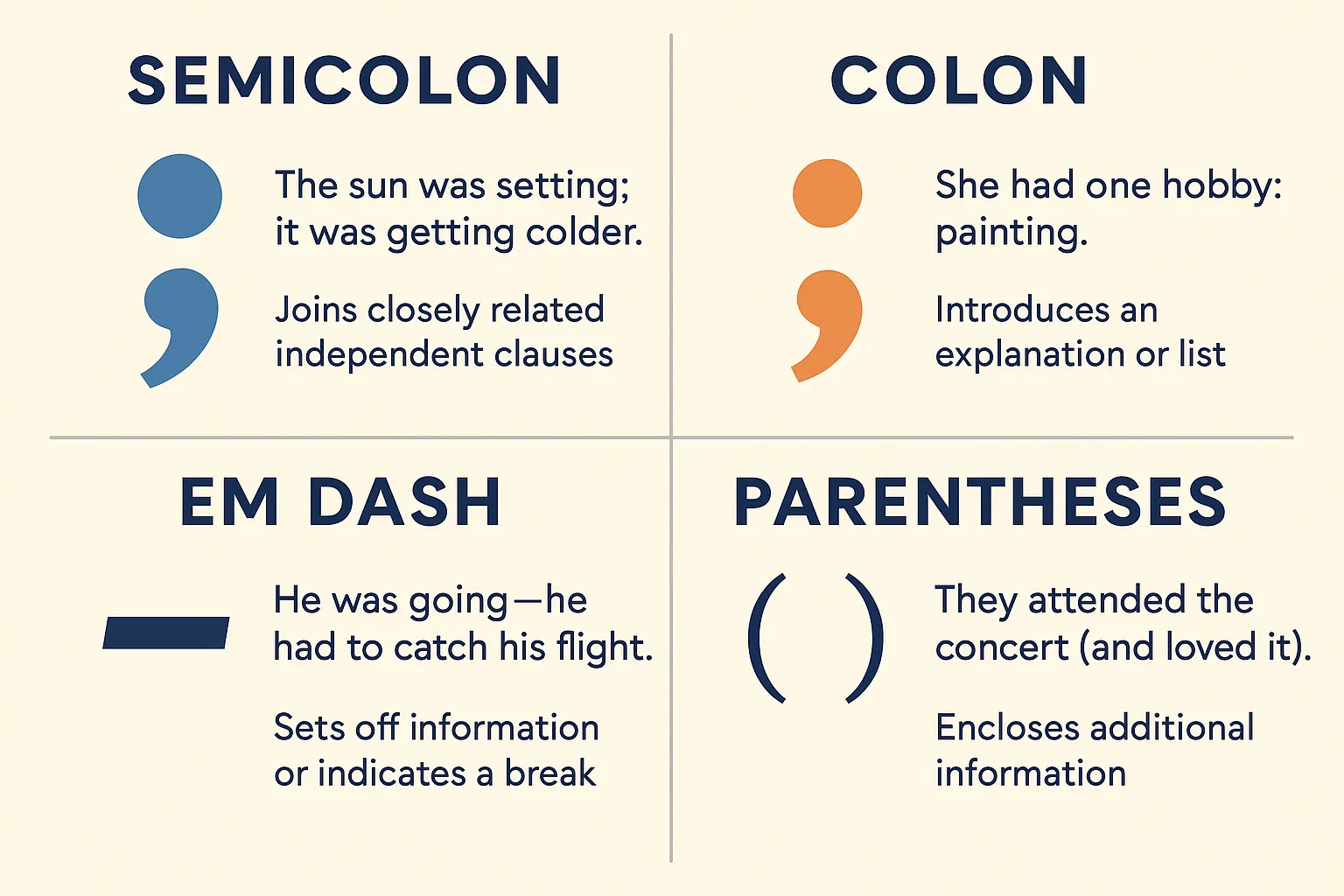
Beyond commas and periods, advanced punctuation—especially semicolons, colons, m-dashes, and parentheses—gives your writing precision and nuance. Mastering these marks allows you to organize complex thoughts, clarify relationships, and achieve stylistic flair.
Semicolons (;)
Function: Semicolons join closely related independent clauses without a coordinating conjunction and separate complex list items with internal commas.
- Formal rule: Use between independent clauses not joined by and, but, or.
Example (strong): She loves advanced grammar; her writing shows it. - In lists: When list items have commas, use semicolons for clarity.
Example: The speakers included Dr. May, a linguist; Ms. Chan, a novelist; and Mr. Lee, a journalist. - Weak usage (avoid): Linking unrelated sentences.
Example: She ate an apple; the train was late. (These thoughts are unrelated; use a period.)
Colons (:)
Function: Colons introduce lists, explanations, illustrations, and quotations after a complete sentence.
- Formal rule: Precede with a complete clause.
Strong: He has three favorite punctuation marks: the semicolon, the m-dash, and the colon. - Stylistic use: Dramatically highlight or explain.
Example: Only one thing stood between her and success: confidence. - Weak usage (avoid): Placing a colon after a verb or preposition.
Weak: His favorite punctuation marks are: semicolons, dashes, and parentheses. (Omit the colon.)
M-dashes (—)
Function: M-dashes break up sentences, add emphasis, indicate interruptions, or replace parentheses/colons for dramatic effect.
- Parenthetical: Insert extra information or an aside.
Example: The conference—long anticipated by attendees—was a success. - Emphasis or surprise: Replace a colon to introduce a twist.
Example: She had one fear—failure. - Weak usage: Overuse in formal writing. Use sparingly for maximal impact.
Parentheses ( () )
Function: Parentheses enclose supplemental information, clarifications, or asides without breaking sentence flow.
- Clarification: Add brief, nonessential info.
Example: The results (see Table 2) were conclusive. - Stylistic choice: Indicate an aside or personal comment, often in informal or creative writing.
- Weak usage: Encapsulating key information in parentheses; this can make writing unclear or signal that details are unimportant.
Punctuation in Different Writing Genres
| Genre | Usage Style | Example |
|---|---|---|
| Academic | Formal, precise | Evidence supports the hypothesis; results are consistent. |
| Creative | Flexible, dramatic | He was faced with a choice—run or fight. |
| Business | Clear, direct | Please review the following: project plan, budget, timeline. |
Takeaway: Choosing the Right Advanced Punctuation
- Semicolons: Link closely related ideas or clarify complex lists.
- Colons: Introduce or highlight information after a complete idea.
- M-dashes: Emphasize, interrupt, or insert asides dynamically.
- Parentheses: Add brief, non-vital clarifications for smoother reading.
Understanding the nuances of advanced punctuation elevates your English, whether you're writing an essay, business email, or creative story. Choose each mark purposefully to express your ideas with clarity and style.