Causative Structures in English: ‘Have,’ ‘Get,’ and Beyond

Master English causative verbs with ‘have’, ‘get’, and other key structures. Learn subtle differences, usage rules, and practical examples.
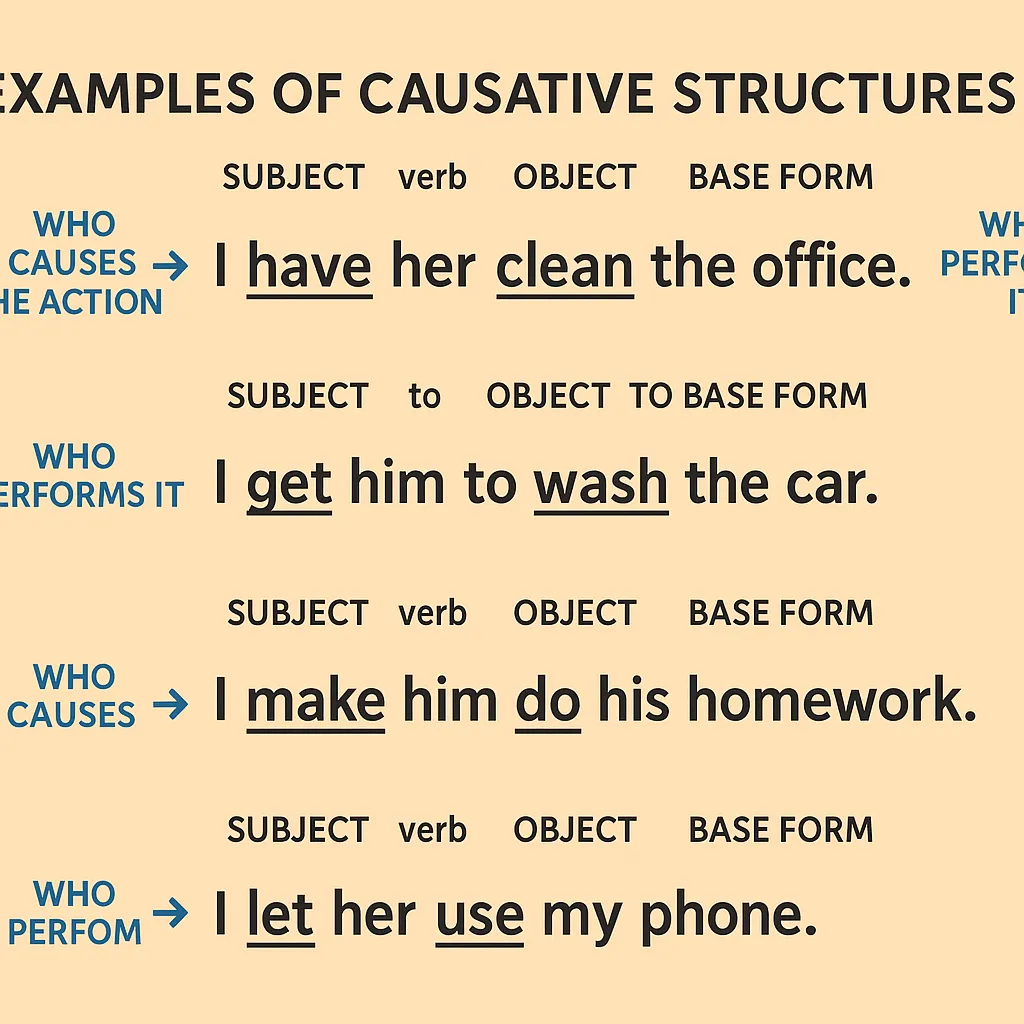
Causative Structures in English: ‘Have,’ ‘Get,’ and Beyond
Causative structures in English allow speakers to express that one person causes another to do something or have something done. Mastering these forms—especially with verbs like have, get, make, and let—is essential for clear, nuanced communication. Let’s break down the grammar, meanings, and best contexts for causative verbs.
What Are Causative Structures?
A causative structure is used when one person causes another to do something, or they arrange for something to be done by someone else. In English, these are often built with have and get in specific patterns.
- Have something done: The action is performed by a third party, often used for services.
- Get someone to do something: Someone is persuaded, told, or arranged to do something.
Causative ‘Have’: Structure and Usage
This form expresses that you arrange for someone to do something for you. The focus is on the result, not who actually performs the action.
- Form: Have + object + past participle
| Example | Meaning |
|---|---|
| I had my car washed. | I arranged for someone to wash my car (not myself). |
| She had her hair cut. | Someone cut her hair for her. |
Notes on ‘Have Something Done’
- Common for services and repairs
- Emphasizes the action/result, not the doer
Causative ‘Get’: Structure and Usage
‘Get’ in causatives often has a similar meaning to ‘have’ but is more informal and sometimes suggests more effort or persuasion.
- Form 1 (like ‘have’): Get + object + past participle
- Form 2: Get + person + to + base verb
| Example | Meaning |
|---|---|
| We got the windows cleaned. | We arranged (possibly with some effort) for someone to clean our windows. |
| She got him to fix her computer. | She persuaded or arranged for him to fix it. |
'Get Someone to Do Something' vs. 'Have Someone Do Something'
- ‘Get’ can imply more effort, persuasion, or difficulty.
- ‘Have’ is more formal, neutral, and often used for paid services.
Other Causative Verbs: ‘Make,’ ‘Let’ and More
Besides ‘have’ and ‘get’, English uses other causative verbs with slightly different meanings.
- Make + person + base verb: To force or require someone to do something.
His parents made him clean his room. - Let + person + base verb: To allow or permit someone to do something.
The teacher let us leave early.
Choosing the Right Causative Structure
- Arrange a service: Use ‘have/get something done’.
I had the house painted. / We got the door repaired. - Persuasion or effort: Use ‘get someone to do something’.
I got my brother to help me move. - Giving orders/forcing: Use ‘make’.
The coach made the players run laps. - Permission: Use ‘let’.
She let her kids stay up late.
Quick Reference Table: Causative Structures
| Structure | Example | Meaning |
|---|---|---|
| have + object + past participle | I had my bike fixed. | Someone fixed my bike for me. |
| get + object + past participle | I got my phone repaired. | I arranged for repair; possibly with some effort. |
| get + person + to + verb | I got him to cook dinner. | I persuaded/arranged for him to cook. |
| make + person + base verb | They made us wait. | They forced us to wait. |
| let + person + base verb | She let them go. | She allowed them to go. |
Final Tips for Mastering Causatives
- Pay close attention to verb patterns and small shifts in meaning.
- Use causative structures to make your speech and writing more precise and natural.
- Start by identifying situations where someone arranges for or causes an action, then pick the structure that matches your intention.
Practice using these structures with your own examples to build fluency and accuracy.