Cultivating a Nuanced Vocabulary

Unlock nuanced vocabulary by understanding connotation, register, collocation, and subtle meaning differences for richer, more precise English.
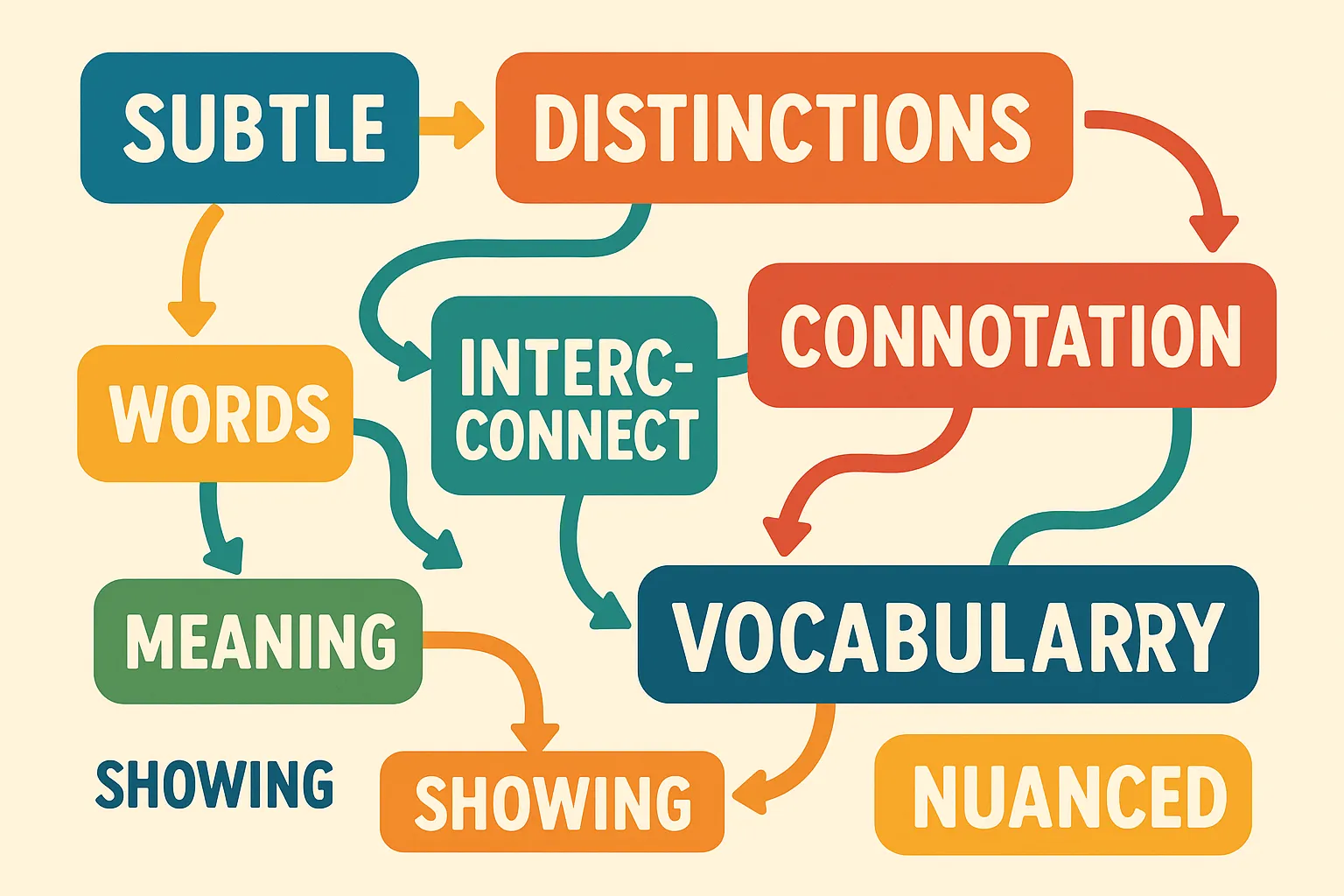
Cultivating a Nuanced Vocabulary: Beyond Synonyms and Antonyms
Building an advanced English vocabulary is not simply about collecting new words or memorizing synonyms and antonyms. True linguistic mastery lies in appreciating the shades of meaning, tone, and context that distinguish closely related words. By developing a nuanced vocabulary, you gain the power to express yourself with precision, elegance, and authenticity—qualities that set advanced English speakers apart.
Why Nuance in Vocabulary Matters
Many English learners plateau after acquiring fundamental vocabulary, finding themselves unsure which of several similar words to choose in a specific context. Mastering nuance unlocks:
- Subtlety: More accurate self-expression
- Confidence: Greater command over tone and register
- Credibility: Professional, academic, and social polish
Strategies to Deepen Vocabulary Knowledge
1. Go Beyond the Dictionary Definition
Many words share dictionary definitions but diverge markedly in connotation, frequency, and appropriateness. For example, "childish" and "childlike" both relate to children, but "childish" carries a negative tone, while "childlike" is often positive. Always examine how a word feels, not just what it denotes.
2. Master Register: Formality Levels
Register refers to the level of formality or informality in language use. Words like "assist" (formal) and "help" (neutral) are often interchangeable, but context determines which is most suitable. Matching your vocabulary to your audience ensures effective communication and helps you fit in socially and professionally.
3. Focus on Collocation Patterns
Native speakers combine words in habitual ways—these common pairings are called collocations. For instance, we say "strong tea" but not "powerful tea," even though "strong" and "powerful" are synonyms. Learning collocations prevents unnatural phrasing and boosts fluency.
4. Dissect Subtle Shades of Meaning
Consider the pair "economic" vs. "economical". Both relate to economy, yet "economic" means 'relating to economics', while "economical" means 'not wasteful'. Such fine distinctions are crucial in academic or professional contexts. Analyzing example sentences and authentic materials can illuminate these subtleties.
| Word Pair | Connotation | Register | Typical Collocation |
|---|---|---|---|
| Childish / Childlike | Negative / Positive | Neutral | Childish behavior, Childlike wonder |
| Suggest / Propose | Neutral | Informal / Formal | Suggest a plan, Propose a solution |
| Economic / Economical | Neutral | Formal / Neutral | Economic growth, Economical car |
Practical Tips for Building a Nuanced Vocabulary
- Notice Context: Pay attention to where and how a word is used in real life.
- Compare Synonyms: Make note of slight differences in tone and usage.
- Record Collocations: Add common word pairings to your vocabulary notes.
- Immerse in Authentic Material: Read widely; exposure sharpens your sense for subtle language.
Conclusion: Transform Your English with Nuanced Vocabulary
Nurturing a nuanced vocabulary empowers you to communicate with sophistication and confidence. By considering connotation, register, collocation, and subtle differences, you'll enrich your self-expression and stand out as a truly advanced English speaker. Ready to take your speaking to the next level? Try SpeakingAI to practice real-life conversations and refine your command of nuanced language!