Ellipsis & Substitution: Streamline English Naturally

Learn how ellipsis and substitution reduce repetition and make English sound fluent and natural. Master usage and logic for effective communication.
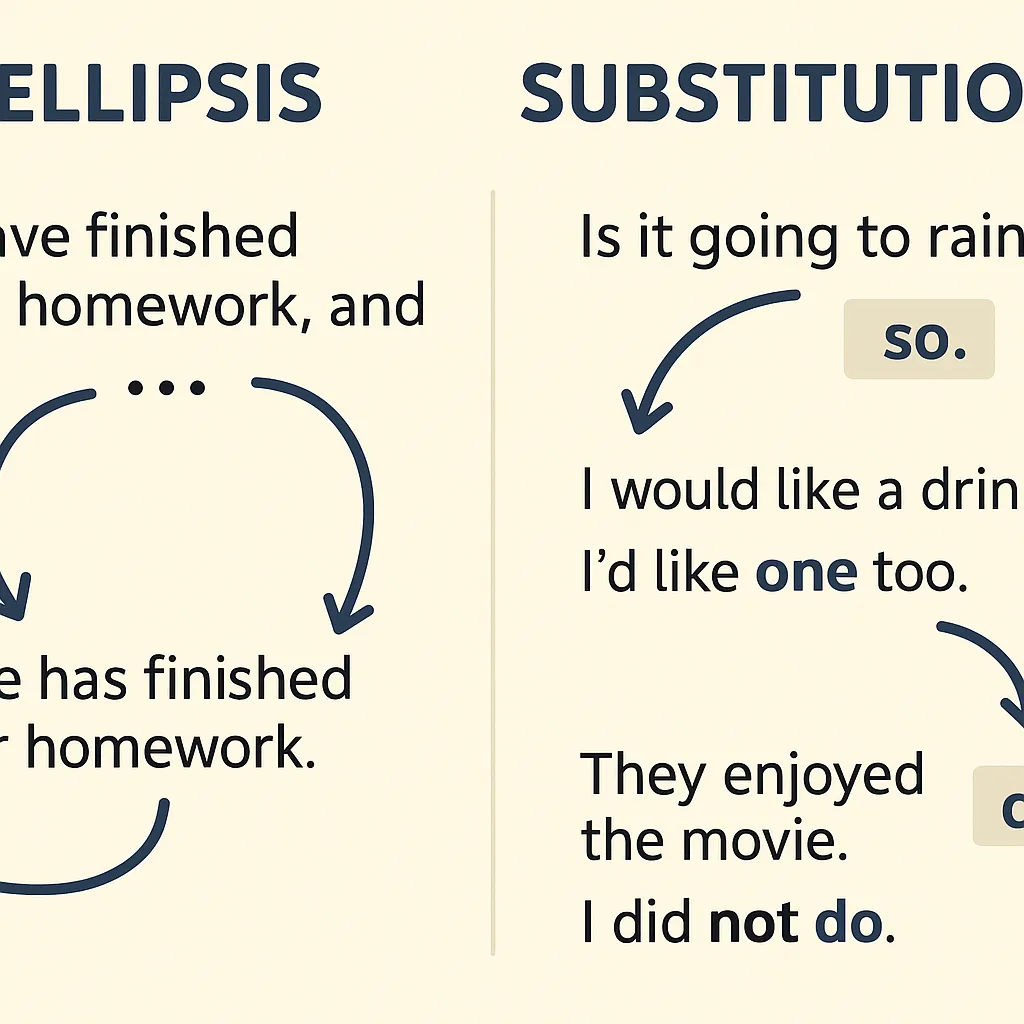
Ellipsis and Substitution: Avoiding Repetition for Natural English
Ellipsis and substitution are essential tools for making English communication clear and fluid. They help speakers sound more fluent while avoiding awkward repetition. Let's break down the mechanics of these techniques and learn how they enhance everyday English.
What Is Ellipsis?
Ellipsis is when words are intentionally left out because they are understood from the context. It is common in both spoken and written English, especially in conversations or connected sentences.
- Original: Margaret likes tennis, and Max likes tennis too.
- With ellipsis: Margaret likes tennis, and Max does too.
Here, “does” replaces “likes tennis,” making the sentence shorter and more natural.
What Is Substitution?
Substitution involves using a word or phrase like "so," "do," or "one" to replace previously mentioned information. This not only streamlines sentences but also prevents repetition.
- “Do/Does/Did” Substitution: Replaces verbs or verb phrases in responses.
Example: He enjoys swimming, and his brother does too. - “One/Ones” Substitution: Replaces nouns or noun phrases.
Example: I prefer the red shirt. Do you like the blue one? - “So/Not” Substitution: Used mainly for comments or confirmations.
Example: She says it will rain, and I think so, too.
Why Ellipsis and Substitution Matter
- Clarity: They make ideas concise and remove unnecessary words.
- Naturalness: They mimic the structure of everyday conversation.
- Focus: They draw attention to new information or contrasts.
Common Patterns of Ellipsis
| Form | Example |
|---|---|
| Subject Ellipsis | (You) Want some coffee? |
| Auxiliary Ellipsis | I bought a ticket, (and) Jenny (did, too). |
| Verb Phrase Ellipsis | He can play the guitar, and I can (play the guitar), too. |
Common Substitution Words in English
- Do / Does / Did: Verbs, often after modal verbs
- One / Ones: Nouns, countable objects
- So: Ideas, statements, clauses
- Not: Negatives, often after modal verbs
Using Ellipsis and Substitution Naturally
The secret to natural speech is recognizing when listeners can fill in the missing information. If the meaning is clear, omitting repeated parts or using a substitute word leads to smooth and fluent English.
- After a repeated action or fact: “I like pizza and she does, too.”
- With repeated objects: “I need a pen. Do you have one?”
- To agree or disagree: “I think it’s important.” – “I think so/not.”
Key Takeaways
- Ellipsis removes repeated words when the meaning remains clear.
- Substitution uses simple words to replace longer phrases or nouns.
- Both strategies make your English sound more fluent and less formal.
- Practice listening for ellipsis and substitution in conversations and try to use them yourself.