Linking Words and Logical Connectors Explained

Master conjunctions and logical connectors for building coherent, convincing English arguments—contrast, cause, sequence, condition, and register clarity.
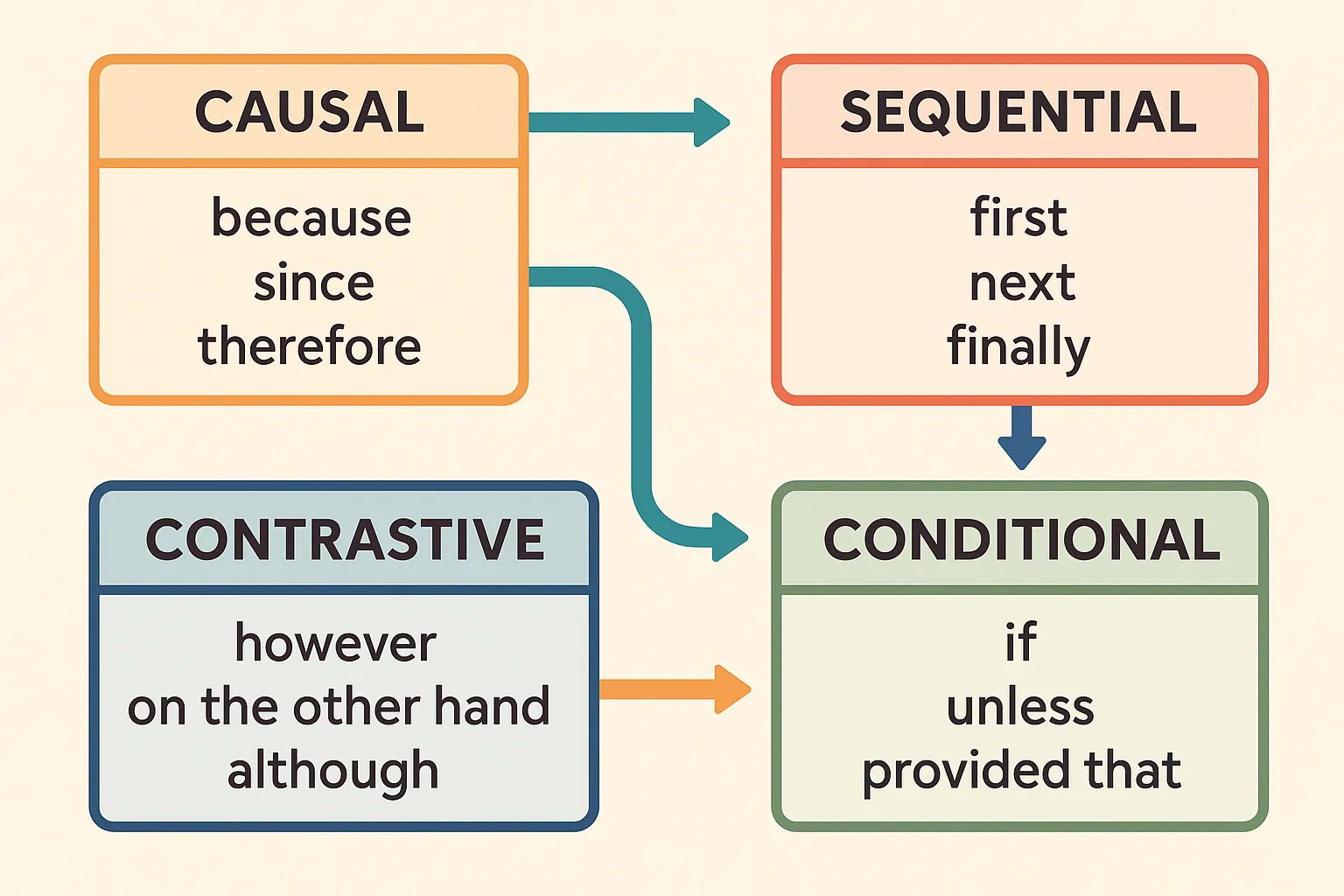
Linking Words and Logical Connectors: Constructing Coherent Arguments
Building clear, logical arguments in English relies on more than vocabulary and grammar. Linking words—also known as logical connectors or connectives—are essential tools that guide readers and listeners through your ideas. Whether you’re writing an essay, a report, or engaging in debate, mastering these connectors will help you convey relationships between thoughts with precision and flow.
Why Linking Words and Connectors Matter
Linking words demonstrate the connections between ideas: they show contrast, cause, effect, sequence, or conditions. Using them correctly not only makes your English more fluent but also clarifies your argument’s logic and structure—skills valued in both academic and professional contexts.
Types of Linking Words and Logical Connectors
- Causal connectors (cause and effect)
- Contrastive connectors (showing difference)
- Sequential connectors (ordering ideas)
- Conditional connectors (expressing conditions)
| Type | Examples | Role |
|---|---|---|
| Causal | because, since, therefore, as a result | Show cause and effect |
| Contrastive | but, although, however, nevertheless, whereas | Show contrast/difference |
| Sequential | first, then, next, finally, subsequently | Order or sequence ideas |
| Conditional | if, unless, provided (that), in case | Show conditions for outcomes |
Causal Connectors
Causal connectors link reasons and results. They answer the questions why and what happens as a result.
- Because, since, as – Introduce causes.
- We left early because it was raining.
- So, therefore, thus, consequently – Express results.
- The project was delayed. Therefore, the launch was postponed.
- As a result, due to, owing to – Signal consequences, often (but not always) more formal.
- Owing to technical issues, the meeting was canceled.
Contrastive Connectors
Contrastive connectors highlight differences, contradictions, or exceptions.
- But, yet – Useful for informal or neutral speech/writing.
- He is talented, but he rarely practices.
- Although, though, even though – Subordinate clauses to show unexpected contrasts.
- Although they tried hard, the team lost.
- However, nevertheless, on the other hand – Often used to begin sentences and add contrast formally.
- The research was thorough. However, the results were inconclusive.
- Whereas, while – Draw direct contrasts between two subjects.
- Some prefer coffee, whereas others prefer tea.
Sequential Connectors
Sequential connectors help organize steps, processes, or arguments. They make your writing easier to follow.
- First, firstly, to begin with – Start a sequence.
- Then, next, after that – Continue a list or process.
- Finally, lastly, in conclusion – Signal the end of a sequence or argument.
- Afterwards, subsequently – Indicate that something follows as a result.
Conditional Connectors
Conditional connectors introduce possible situations and their consequences. They’re key for hypothetical or uncertain scenarios.
- If – The most basic conditional connector.
- If you study regularly, your grammar will improve.
- Unless – Means 'if not.'
- You can’t enter unless you show your ID.
- Provided (that), as long as – Suggest necessary conditions (often more formal).
- You may use the room provided that you keep it clean.
- In case – For precautionary reasons.
- Take an umbrella in case it rains.
Formal vs. Informal Linking Words: Making the Right Choice
Register (formality) matters. Some connectors suit spoken, casual English (but, so), while others are better for essays and professional writing (however, therefore, moreover). Choosing appropriate connectors creates the right tone and strengthens credibility.
- Informal example: So, we need to leave soon.
- Formal example: Therefore, it is necessary to depart promptly.
Connecting It All: Your Argument, Stronger and Clearer
Linking words and logical connectors are the framework of effective English arguments. Used thoughtfully, they clarify relationships between points—be it contrast, cause, sequence, or condition—and help you control the level of formality. Practice them consciously for fluent, persuasive communication.