Mastering Negation: Not Only, Neither/Nor, and Double Negatives

Learn how negation is expressed in English with not only, neither/nor, double negatives, and more for confident, accurate communication.
Mastering Negation: Not Only, Neither/Nor, and Double Negatives
Negation is essential for clear, precise communication in English. Understanding the different ways English expresses negativity helps learners avoid common mistakes, from simple 'not' sentences to complex structures like not only...but also, neither/nor pairings, and the pitfalls of double negatives.
Overview: How English Expresses Negation
Negation lets speakers deny, refuse, or contradict. English uses negative words, phrases, and specific constructions. Mastering them helps convey both polite and emphatic ideas accurately.
- Simple negation: Not, no, never, nothing, nobody, etc.
- Complex negation: Not only... but also, neither/nor, negative adverbials
- Double negatives: Two negatives in a sentence, sometimes incorrect
Simple Negation in English
The backbone of negation uses 'not' and compounds:
- Verb negation: He is not coming. She does not like coffee.
- Negative pronouns and adverbs: nothing, nobody, nowhere, never (Nobody knows. She never eats meat.)
Advanced Negation Structures
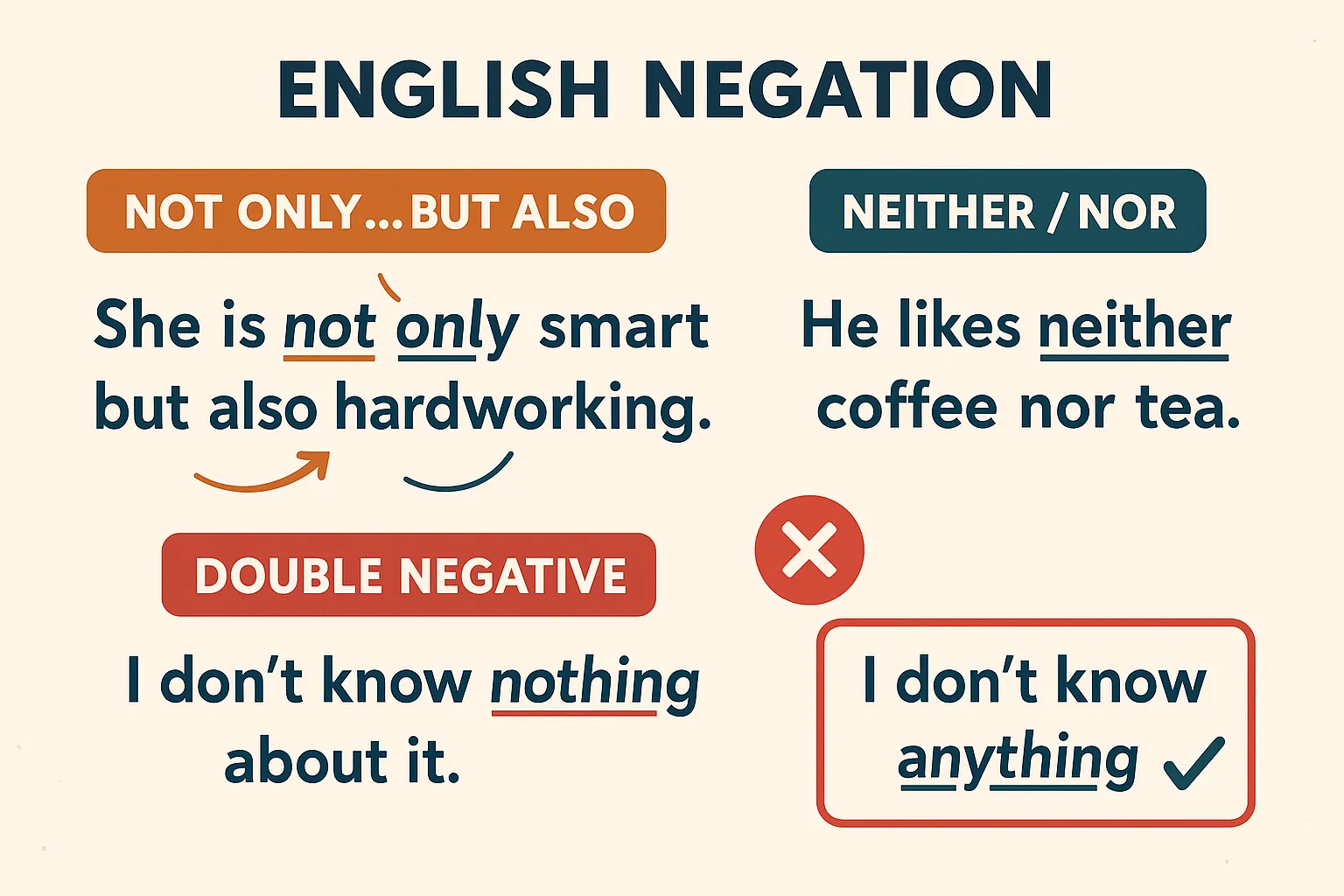
Not Only... But Also
This structure emphasizes two positive or negative ideas:
- Emphatic negation: Not only did he forget my birthday, but he also didn’t call me.
- Not only is placed before the first item/idea; but also introduces the second.
- Often used for emphasis and sometimes requires inverted word order with auxiliaries.
Neither/Nor
Used to link two or more negative ideas. It replaces 'not... either':
- Neither Mary nor John can attend the meeting.
- I like neither tea nor coffee.
- The verb agrees with the subject closest to it.
| Structure | Example |
|---|---|
| Not... either | He doesn't like apples. I don't either. |
| Neither... nor... | Neither he nor I like apples. |
Negative Adverbials and Inversion
Negative adverbials (never, rarely, hardly, etc.) may be placed at the beginning for emphasis, triggering inversion:
- Never have I seen such determination.
- Rarely does she make mistakes.
Double Negatives: Caution and Clarity
A double negative uses two negative words in the same clause. In standard English, this often creates confusion or gives an unintended positive meaning.
- I don't know nothing. (incorrect: means you know something)
- Standard: I don't know anything.
- Double negatives can sound emphatic or informal in some dialects, but should be avoided in formal English.
Polite vs. Emphatic Negation
The choice of negative structure can affect tone. Simple negatives are often more polite. Complex forms (not only, never have I) sound emphatic or formal. Adjust your negation for the situation:
- Polite: I’m sorry, I can’t help you today.
- Emphatic/formal: Not only am I unable to help, but I also lack the resources.
Key Takeaways for Mastering Negation
- Use 'not' + verb or negative pronouns/adverbs for simple negation.
- Apply 'not only... but also' and 'neither/nor' for emphasis and linking negative ideas.
- Avoid double negatives in formal writing and speech.
- Choose simple structures for politeness; complex ones for emphasis.
By mastering both simple and advanced negation techniques, you will express yourself more clearly and confidently in English.