Negation with Prefixes: Un-, In-, Dis-, and More

Master English negation with prefixes like un-, in-, dis-, and non-. Learn prefix usage, nuanced meanings, common pitfalls, and differentiation tips.
Negation with Prefixes: Un-, In-, Dis-, and More
English expresses negation and opposition in subtle yet systematic ways using prefixes like un-, in-, dis-, and non-. Even advanced learners can struggle to choose the correct form—uncomfortable, impossible, disagree, or nonexistent? Understanding these negative prefixes is essential for accuracy and confidence in speaking and writing.
How Prefixes Convey Negation in English
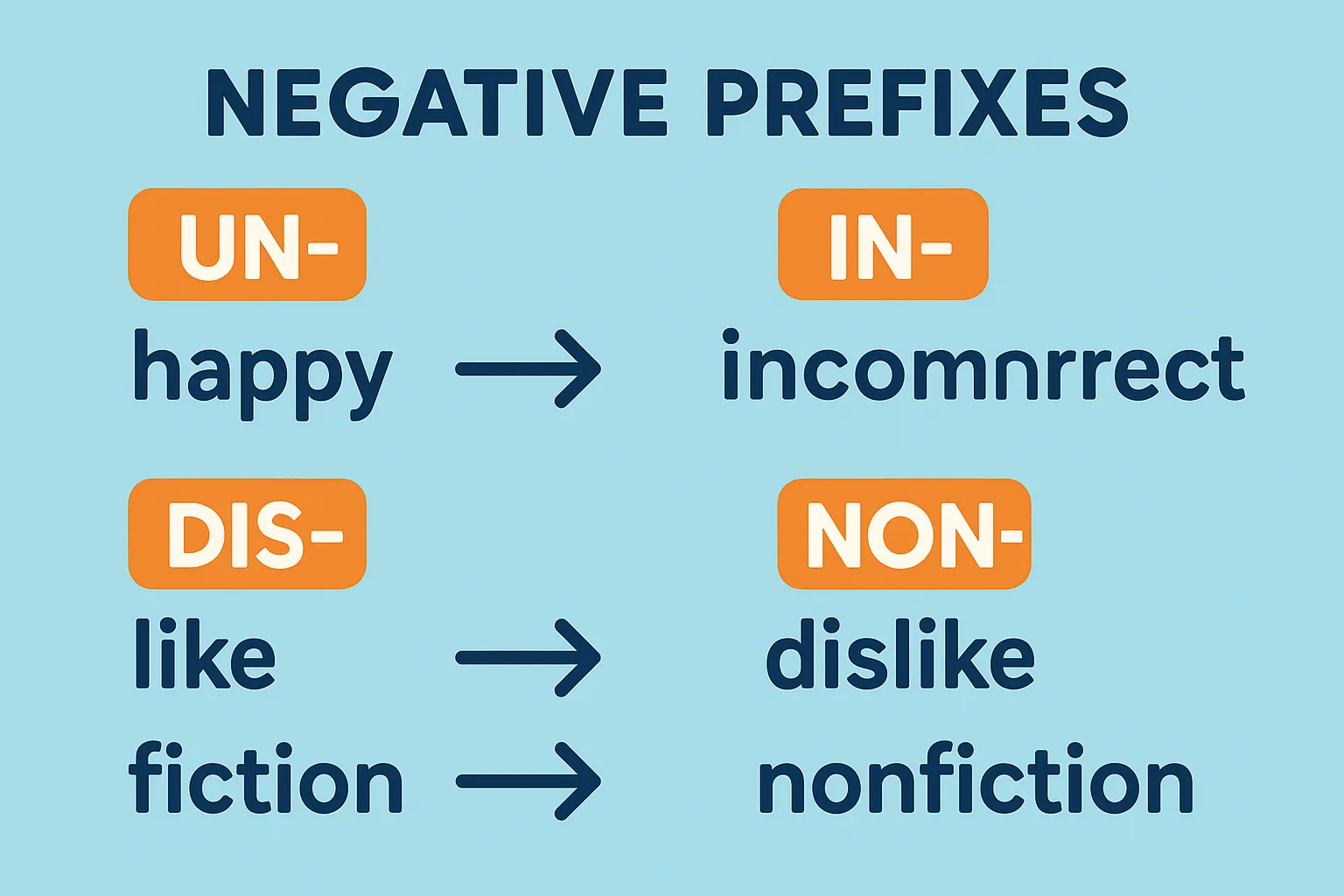
Negative prefixes attach to the roots of words to express the opposite, absence, or denial of meaning. Here’s what you need to know about the main ones:
- Un-: The most common negation prefix. It means 'not' or 'the opposite of.' (unhappy, unknown, unsafe).
- In-: Also means 'not,' but often appears with Latin-origin words. Forms include in-, im-, il-, ir- ( invisible, impossible, illegal, irregular).
- Dis-: Expresses 'not,' 'lack of,' or 'opposite action.' Often used for verbs and adjectives (disagree, dislike, dishonest).
- Non-: Means 'not' or 'without,' typically used more formally and without emotional tone (nonexistent, nonprofit).
Choosing the Right Prefix: Patterns and Exceptions
While some guidelines exist, learning the correct prefix often relies on familiarity and experience. The table below summarizes usage patterns:
| Prefix | Meaning | Commonly Used With | Example Words |
|---|---|---|---|
| Un- | Not; opposite of | Adjectives (esp. of English origin), participles | unhappy, untidy, unsafe, unlocked |
| In-/Im-/Il-/Ir- | Not | Adjectives (esp. of Latin origin) | incomplete, impossible, illegal, irregular |
| Dis- | Not; absence of; the reverse | Verbs, adjectives, some nouns | disagree, disappear, dishonest, discomfort |
| Non- | Not; absence of | Adjectives, nouns; often formal/technical | nonstop, nonresident, nonprofit |
Meaning Nuances: More Than Just "Not"
- Un- often suggests a simple negative or a reversal: unlock (reverse the act of locking).
- Dis- can show active opposition: disagree (to hold an opposing view) or removal: disconnect.
- Non- simply negates or states the absence of something, with a more neutral tone: nonessential (not essential).
Pronunciation Pitfalls
Negation prefixes can cause pronunciation confusion, especially in-/im-/il-/ir-. The spelling adapts to the following letter for easier speech:
- In- becomes im- before p, b, m: impossible, imbalanced, immortal.
- In- becomes il- before l: illegal.
- In- becomes ir- before r: irregular.
- Dis- can sound like /dɪs/ or /dɪz/ depending on the root: dɪsˈɡriː (dis-agree), dɪzˈɡʌst (dis-gust).
Comparison With Other Negative Forms
Negative prefixes serve a different function than other negation forms in English:
- Negative adverbs: not, never, without
- Negative suffixes: Less common, but notable—e.g., worthless (the suffix -less means 'without')
Use prefixes for word formation; use negative adverbs for sentence-level negation.
Quick Activities: Distinguishing Negation Prefixes
- Make pairs: Which is correct—unvisible or invisible?
- Choose the negative: unlegal, illegal; nonexistent, unexistent; distrust, untrust.
- Listen and repeat: Practice minimal pairs—discover vs. uncover; disagree vs. unagree (the latter does not exist).
Tips to Master Prefix Negation
- Check a dictionary when in doubt—some pairs are idiomatic.
- Make your own list of commonly confused words with negative prefixes for regular review.
- Listen for prefix pronunciation in authentic speech and practice repeating them aloud.
Understanding how and when to use negative prefixes like un-, in-, dis-, and non- boosts your accuracy and makes your English sound more natural and confident. Keep exploring words, note patterns, and remember: small prefixes have big power!