Relative Adverbs: When, Where, and Why They Matter

Master how to use relative adverbs 'when,' 'where,' and 'why' to connect ideas smoothly and add clarity to your English sentences.
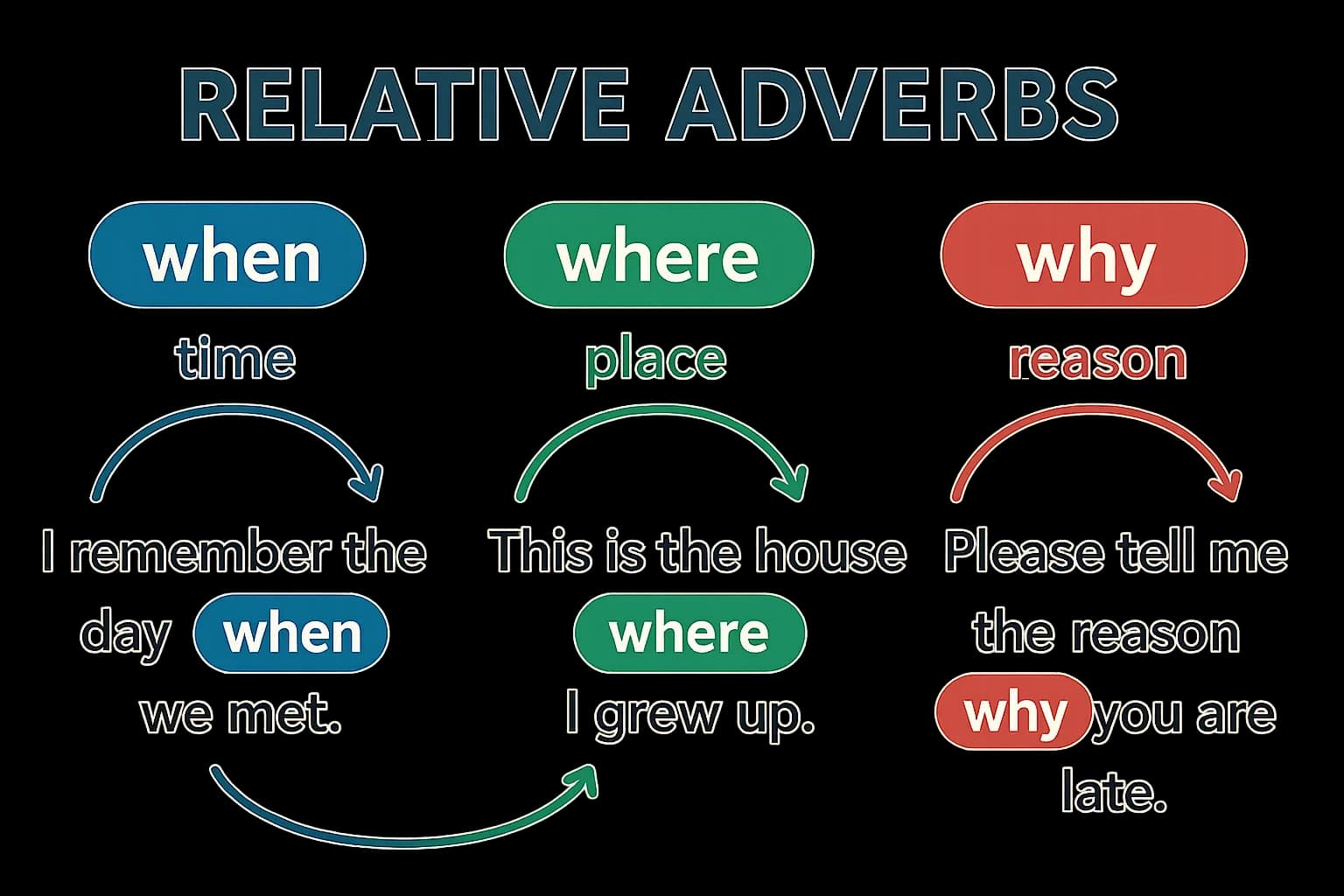
Relative Adverbs: When, Where, and Why They Matter
Relative adverbs are vital tools that add clarity, flow, and nuance to your English communication. Words like when, where, and why introduce relative clauses, help connect ideas logically, and often replace longer prepositional phrases. Understanding their use will make your writing and speech more fluid and precise.
What Are Relative Adverbs?
Relative adverbs are words that introduce a relative clause and relate it to a noun in the main clause. The main relative adverbs are when, where, and why. They serve to connect ideas effectively within a sentence.
| Relative Adverb | Refers to | Example |
|---|---|---|
| when | a time | This was the year when I moved. |
| where | a place | That is the park where we met. |
| why | a reason | She told me the reason why she left. |
How Do Relative Adverbs Work?
- Introduce Relative Clauses: Relative adverbs start clauses that give extra information about a noun (usually a place, time, or reason).
- Connect Ideas: They link the information smoothly, preventing awkward or repetitive sentences.
- Replace Prepositions: Relative adverbs often take the place of a preposition + relative pronoun combination.
Relative Adverbs vs. Prepositional Phrases
Relative adverbs make sentences cleaner by replacing phrases like in which, at which, or for which. Compare:
- That was the day when we met.
- vs. That was the day on which we met.
- That’s the house where I grew up.
- vs. That’s the house in which I grew up.
- She explained the reason why she left.
- vs. She explained the reason for which she left.
Nuances and Common Pitfalls
- Avoid Redundancy: Never use a preposition and a relative adverb together (e.g., "the time when at…").
- Optional Use: For "why," often "the reason" is enough: "the reason she left" (not always "the reason why she left"). However, "why" adds clarity and is standard in spoken English.
- Not for All Nouns: Only use these adverbs after nouns of time (when), place (where), or reason (why). For people or things, use relative pronouns (who, which, that).
Contrasting Examples
| With Relative Adverb | With Preposition + Pronoun |
|---|---|
| This is the café where we met. | This is the café in which we met. |
| Can you recall the year when you graduated? | Can you recall the year in which you graduated? |
| No one explained the reason why it happened. | No one explained the reason for which it happened. |
Summary: Why Relative Adverbs Matter
- Simplify complex sentences
- Create smooth connections
- Add precision and clarity
- Help express time, place, and reason concisely
Mastering relative adverbs boosts your confidence in writing and speaking, helping you connect ideas naturally—an essential skill for English exams and everyday fluency.