Using Etymology as a Learning Tool

Discover how studying word origins strengthens vocabulary, memory, and deeper understanding of English semantics.
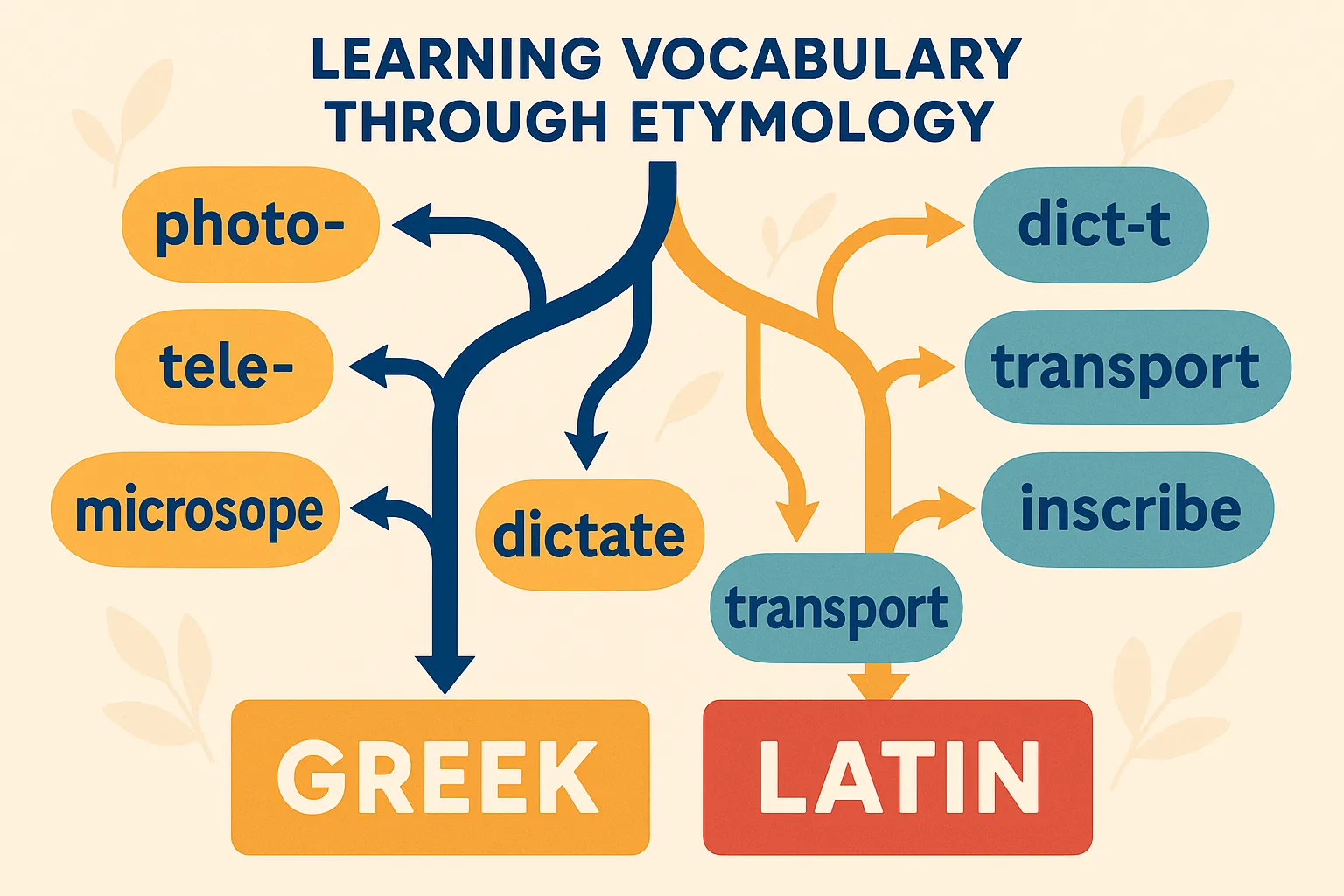
Using Etymology as a Learning Tool: Tracing Roots to Unlock Meaning and Memory
Etymology—the study of word origins and their historical evolution—is a powerful yet underutilized strategy in advanced English learning. Beyond simple definitions, etymological knowledge revives the story behind each term, offering unique pathways to retention, semantic clarity, and vocabulary growth. In this guide, you will uncover the enduring value of etymological insight and proven techniques to harness it for superior language acquisition.
Why Etymology Matters for Vocabulary Acquisition
- Cognitive Anchoring: Understanding roots, prefixes, and suffixes helps anchor new vocabulary in your memory by connecting unfamiliar words with familiar elements (e.g., benevolent: bene = good, volent = wishing).
- Semantic Networks: Etymological study uncovers shared origins among words, revealing patterns (e.g., spectator, inspect, retrospective—all from the Latin specere, “to look”).
- Increased Retention: Relating a word’s structure to its meaning turns vocabulary into memorable narratives rather than isolated facts.
- Strategic Guessing: When encountering unfamiliar words, knowledge of Greek or Latin roots empowers learners to infer meaning reliably.
Decoding and Remembering Advanced Vocabulary Through Roots
Many complex English words draw from Greek and Latin elements. By breaking them down, you transform intimidating terms into manageable components:
| Word | Root(s) | Root Meaning | Word Meaning |
|---|---|---|---|
| Transmit | trans-, mit(t) | across, send | To send across |
| Amorphous | a-, morph | without, shape/form | Without a clear shape |
| Philanthropy | phil-, anthropos | love, human | Love of humanity |
| Chronology | chron-, -logy | time, study | Study of time/order of events |
Practical Methods: Leveraging Etymology in Everyday Learning
- Break Down Words Systematically: When you learn an advanced word, dissect it—identify its roots, prefixes, and suffixes, and explore their original meanings.
- Create Visual Maps: Build mind maps linking words with shared roots (e.g., beneficial, benign, benefactor—all with bene, “good”).
- Record and Reflect: Keep a dedicated etymology journal; annotate new vocabulary with root meanings and related words to reinforce memory.
- Leverage Thematic Clusters: Group vocabulary by root themes (e.g., bio- for life: biology, biography, antibiotic), noticing patterns across disciplines.
Unlocking Deep Connections and Lifelong Learning
Etymology transforms vocabulary development from rote memorization into a structured, interconnected process. By tracing word origins, learners not only expand their lexical repertoire but also discover the historical paths words have traveled, adding nuance and intellectual richness to their expression. Embrace etymological study as more than a linguistic curiosity: let it elevate your command of English—and your appreciation for its intricate tapestry of meaning.