Data Visualization Language: Describing Charts and Graphs

Master professional English vocabulary and structures to confidently describe charts, graphs, and visuals in business presentations and reports.
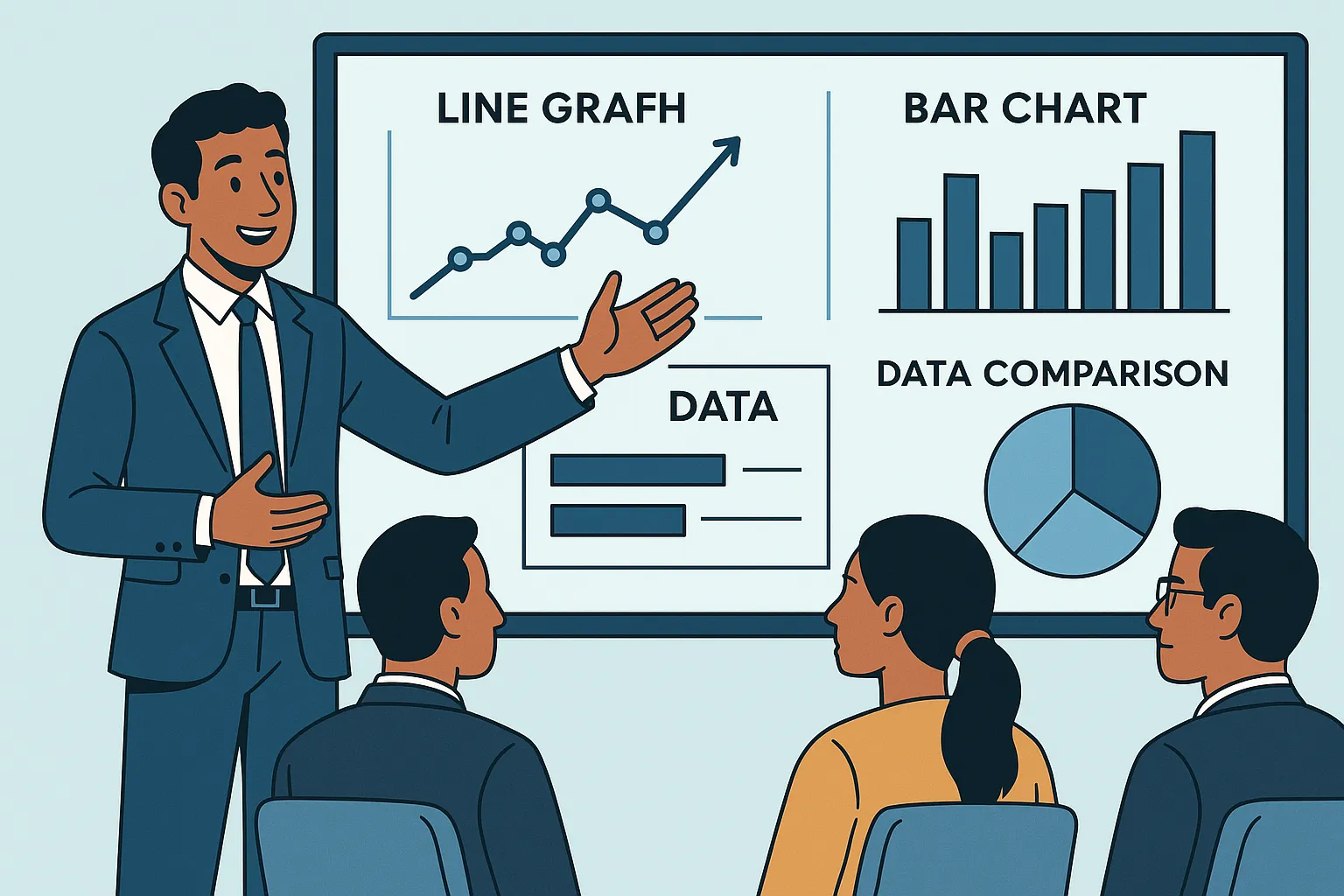
Data Visualization Language: Describing Charts and Graphs Professionally in English
Presenting data accurately and persuasively is essential in business reports and meetings. Expressing trends, comparisons, and key insights from charts and graphs in clear, professional English improves your impact as a communicator. This guide provides the essential vocabulary, phrases, and structures for describing line graphs, bar charts, and complex data visuals.
Why Data Visualization Language Matters
Business decisions often depend on data visualizations. Being able to describe trends, outliers, and changes precisely in English demonstrates your competence and builds trust. Effective language also makes complex information accessible to your audience.
Core Vocabulary for Describing Charts and Graphs
| Function | Useful Words & Synonyms |
|---|---|
| Trend | rise, increase, grow, climb, decline, fall, drop, decrease, fluctuate, level off |
| Speed/Strength | sharply, significantly, steadily, gradually, slightly |
| Comparison | higher/lower than, similar to, compared to, whereas, while |
| Outlier | peak, the highest/lowest point, exception, anomaly, spike |
| Time/Sequence | initially, then, subsequently, finally, over the period |
Describing Line Graphs
Line graphs show changes over time. Focus on the direction, speed, and any sharp shifts.
- There was a significant increase in sales from January to March.
- After reaching a peak in July, revenue steadily declined.
- The number fluctuated throughout the year, but ended at a higher level.
Describing Bar Charts
Bar charts compare quantities across categories. Use comparative structures and highlight notable differences.
- Product A outperformed all other categories in 2023.
- The Western region had a slightly lower sales volume compared to the Eastern region.
- Sales of Product C remained relatively stable, while Product B saw a sharp decline.
Describing Complex Visuals and Outliers
For pie charts, stacked bars, or combined visuals:
- Nearly half of the total market share belongs to Segment A.
- Unlike the other segments, Segment D experienced a notable spike.
- The data reveals an anomaly in 2022, deviating from the consistent growth pattern.
Grammatical Structures for Data Commentary
- Passive voice: A steady rise was observed in Q2.
- Comparatives/Superlatives: This quarter was the most profitable.
- Time linkers: Initially, figures were low; however, they improved steadily.
Professional Phrases for Business Contexts
- As illustrated in the chart, …
- The graph clearly indicates that …
- It is evident from the data that …
- This suggests a strong upward/downward trend.
- One notable outlier is …
Tips for Impactful Data Presentations
- Summarize key findings before explaining details.
- Quantify whenever possible: "by 20%", "reaching 1.2 million".
- Highlight exceptions or turning points to guide audience focus.
- End with a clear conclusion or recommendation based on the data.
Conclusion
Developing your data visualization language allows you to present charts and graphs with confidence and professionalism. Mastering this skill will help you communicate stronger insights and make a greater impact in business settings.