Decoding Embedded Relative Clauses

Learn how to identify, parse, and master sentences with embedded (nested) relative clauses for clear, advanced English.
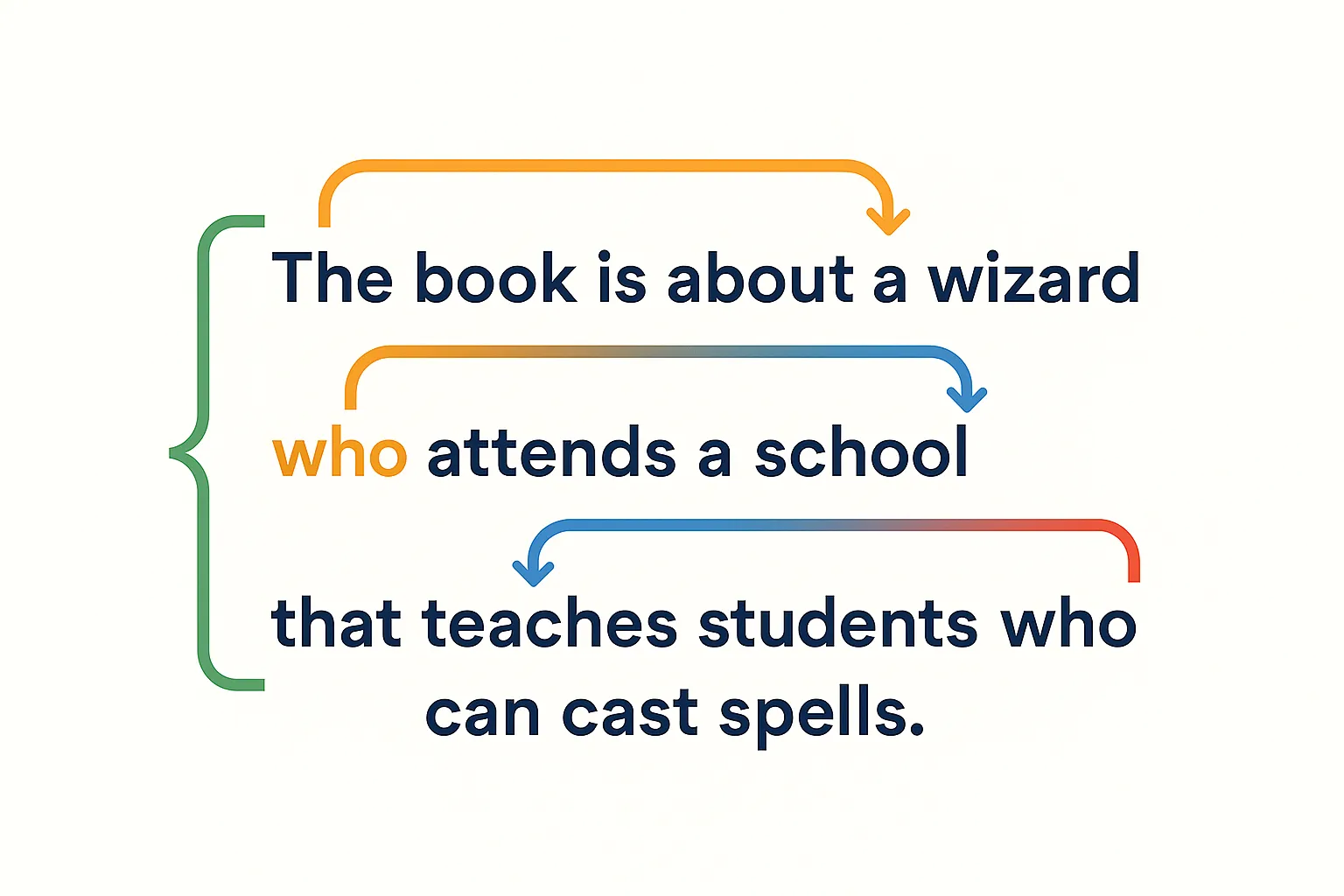
Decoding Embedded Relative Clauses: Sentences Within Sentences
If you’ve ever stumbled over sentences with layers of detail, you’ve likely encountered embedded relative clauses—a feature of advanced English where one clause exists inside another. Mastering these helps you both understand and write sophisticated sentences with precision.
What Is an Embedded (or Nested) Relative Clause?
A relative clause adds information about a noun using words like "who," "which," or "that." An embedded or nested relative clause is a relative clause placed inside another clause, often inside another relative clause.
- Simple relative clause: The girl who won the prize is here.
- Embedded relative clause: The girl who said that she knew the man who won the prize is here.
Why Are Embedded Clauses Challenging?
These structures can be long, contain several descriptive ideas, and make it hard to track what describes what. But decoding them follows a clear logic and helps you in reading, writing, and exams.
How to Parse and Understand Embedded Relative Clauses
- Find the main clause. Identify the core message of the sentence.
- Spot the relative clauses. Look for "who," "which," or "that" introducing more information about nouns.
- Work layer by layer. Start from the outer clause and move inward to understand which noun each clause describes.
Step-By-Step Breakdown: An Example
Sentence:
The man who said that he saw the suspect who ran away is here.
| Layer | Clause | Describes |
|---|---|---|
| Main | The man ... is here. | Main action |
| First relative | who said that he saw the suspect ... | Describes "the man" |
| Embedded relative | who ran away | Describes "the suspect" |
- The main subject: the man
- What about him? He is the one who said [something].
- What did he say? That he saw the suspect [who ran away].
- Which suspect? The one who ran away.
Tips for Clarity and Effective Punctuation
- Use commas for non-defining clauses (extra, non-essential info). E.g., "My sister, who lives abroad, is visiting."
- No commas for defining clauses (essential info). E.g., "Students who study pass exams."
- Break down long sentences when writing if clarity is lost. E.g., "The teacher, who spoke to the student who failed, gave extra help." Try: "The teacher spoke to the student who failed and gave extra help."
Visualizing Embedded Clauses: Progressive Diagramming
- Step 1: Write the main sentence: The man is here.
- Step 2: Add the outer relative clause: The man who said that he saw the suspect is here.
- Step 3: Nest the embedded clause: The man who said that he saw the suspect who ran away is here.
Rewriting for Simplicity
Break complex sentences into shorter ones:
- Complex: The documents that I found in the folder that was hidden in the drawer are important.
- Simplified: The folder was hidden in the drawer. I found documents in it. They are important.
Key Takeaways
- Embedded relative clauses add structured detail, but can become complex.
- Identify the main clause, then unpack each layer step by step.
- Use punctuation carefully for clarity, especially in long sentences.
- Breaking and diagramming sentences helps with both understanding and writing.
Mastering embedded relative clauses sharpens your English reading and writing, helping you navigate and create advanced texts with confidence.