English Communication for CSR & Sustainability Reporting

Master the language, tone, and structure of effective ESG communication for corporate social responsibility and sustainability reporting.
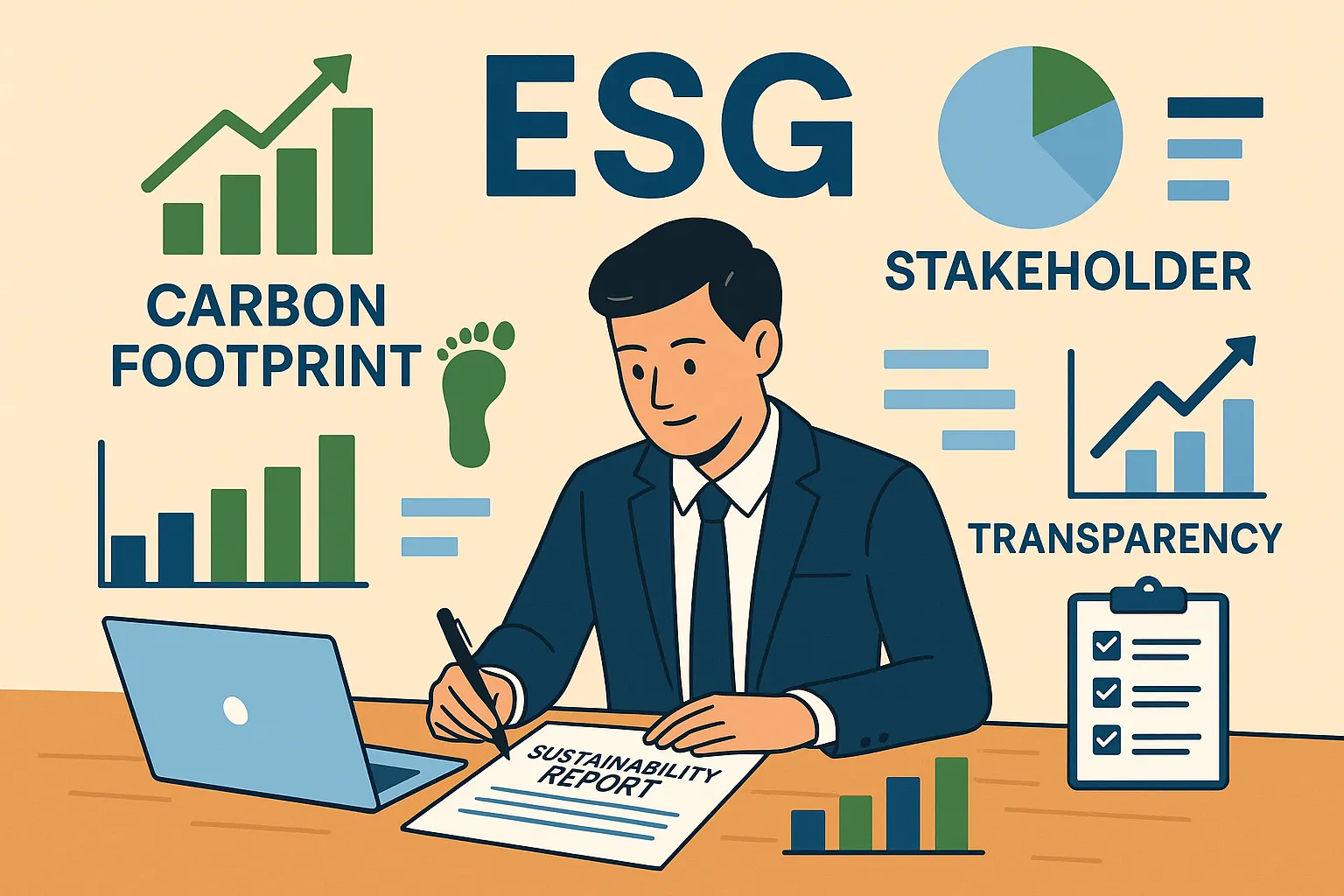
English Communication for Corporate Social Responsibility and Sustainability Reporting
Clear, credible ESG (Environmental, Social, and Governance) communication is essential for modern business reporting. Companies need to share sustainability achievements, disclose impacts, and meet stakeholder expectations with precision and transparency. This guide covers essential language, conventions, and phrasing for professional CSR and sustainability reports.
1. Fundamentals of ESG & CSR Communication
- Clarity and Honesty: Use precise language, avoid vague statements.
- Consistency: Align tone and terminology throughout the report.
- Objectivity: Support claims with data and measurable outcomes.
- Audience Focus: Write for stakeholders, investors, regulators, and the broader public.
2. Core Vocabulary for Sustainability Reporting
| Term | Use in Context |
|---|---|
| Carbon footprint | "We reduced our carbon footprint by 15% over 2023." |
| Stakeholder | "Engaging stakeholders ensures transparent decision-making." |
| Materiality | "A materiality assessment guided our reporting priorities." |
| Governance | "Corporate governance practices are reviewed annually." |
| Sustainable sourcing | "We prioritize sustainable sourcing in our supply chain." |
| Alignment with SDGs | "Our strategy aligns with 5 UN Sustainable Development Goals." |
3. Phrase Bank: Structuring ESG Statements
- Presenting Results: "This year, we achieved a significant reduction in ..."
- Stating Commitments: "We remain committed to advancing ..."
- Describing Initiatives: "Initiatives launched in 2023 focused on ..."
- Reporting Progress: "As part of our ongoing efforts, we ..."
- Addressing Challenges: "Despite challenges in supply chain optimization, we ..."
- Highlighting Impact: "Our programs generated measurable improvements in ..."
4. Stylistic Conventions
- Tone: Professional, factual, and objective. Avoid exaggeration or overly promotional language.
- Structure: Organize content by pillars (Environmental, Social, Governance), or by key themes.
- Data Integration: Reinforce statements with figures, tables, or infographics.
- Active Voice: Prefer active over passive constructions to convey accountability (e.g., “The company achieved …” rather than “It was achieved…”).
5. Sample Excerpts from Sustainability Reports
Use these examples as models for your writing:
- Environmental Section:
“In 2023, the company achieved a 22% reduction in greenhouse gas emissions, surpassing our annual target. We invested in energy-efficient technologies and transitioned 40% of our facility operations to renewable energy sources.” - Social Section:
“We strengthened community engagement by launching educational programs, impacting over 10,000 beneficiaries. Employee health and safety remained a priority, with incident rates declining 18%.” - Governance Section:
“Our governance framework was enhanced through the introduction of regular diversity and ethics training. Independent audits verified full compliance with industry standards.”
6. Final Tips for Impactful ESG Communication
- Review for clarity and conciseness before publishing.
- Use headers, bullet points, and tables for readability.
- Ensure all claims are substantiated with credible data.
- Adopt inclusive language reflecting stakeholder diversity.
Mastering the conventions and vocabulary of ESG communication strengthens your company’s credibility and builds trust with stakeholders. Use the phrase banks and real-world examples above to elevate your next Corporate Social Responsibility or Sustainability Report.