Inversion in English: Grammar, Usage, and Style

Master English subject-verb inversion for questions, emphasis, and stylistic impact with clear explanations and practical usage examples.
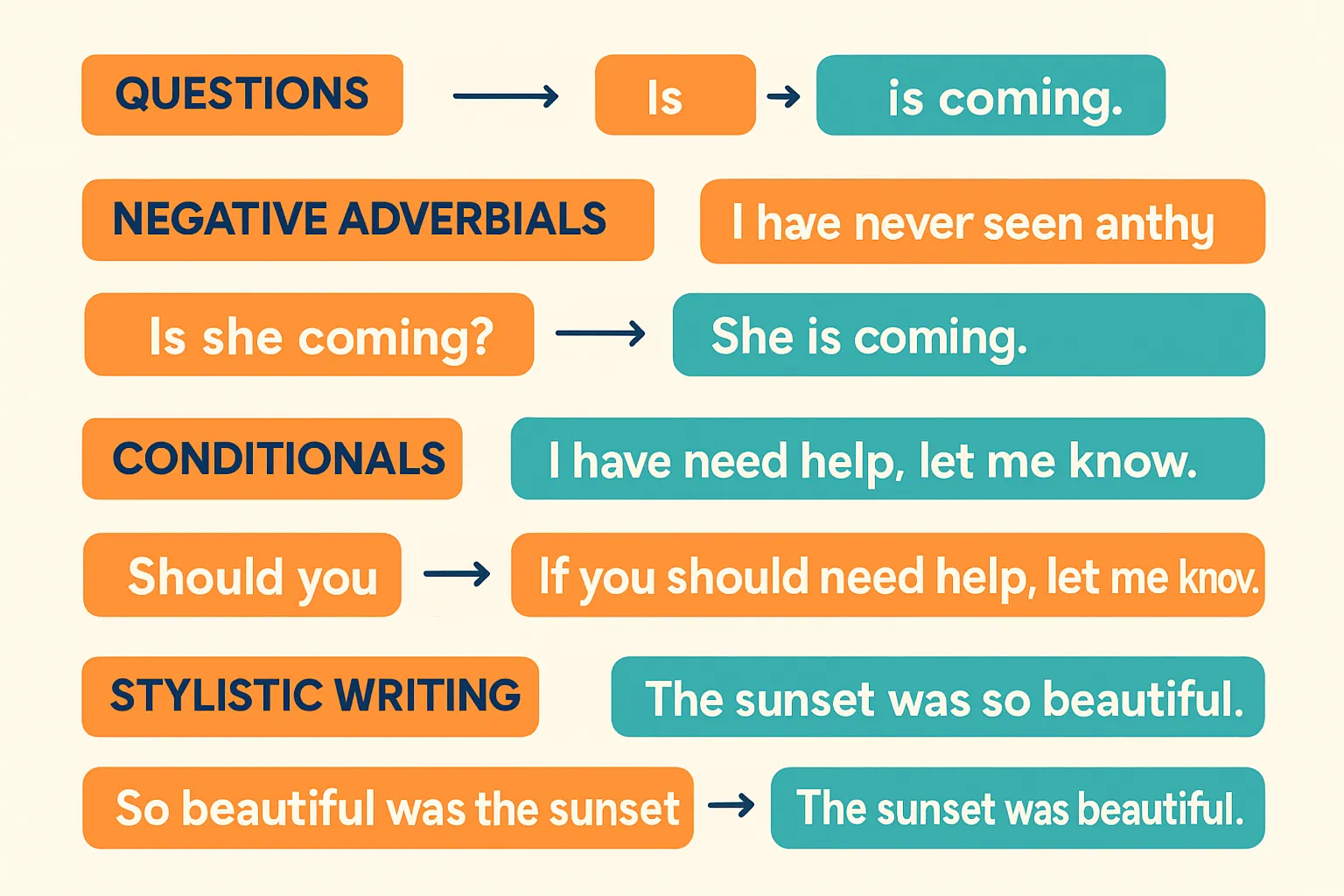
Inversion in English: Grammar, Usage, and Style
Inversion in English isn’t just for asking questions. This powerful structure also appears for emphasis, after negative adverbials, and in elegant written forms. Understanding inversion unlocks advanced sentence variety and precise meaning—essential skills for fluent communication and exam success.
What Is Inversion in English?
Inversion means switching the usual subject-verb word order. In standard English, the subject normally comes before the verb (“She sings beautifully”). Inversion flips this, usually placing the verb (or auxiliary/modal) before the subject (“Never have I heard such singing”).
1. Inversion for Questions
- Yes/No questions: Are you ready? (Not: You are ready?)
- Wh- questions: Where did you go?
- Auxiliary/modal first: Can she come?
This is the most familiar use—the verb precedes the subject to indicate a question.
2. Inversion with Negative Adverbials (Emphatic Inversion)
When certain negative or restrictive expressions begin a sentence, inversion emphasizes rarity, surprise, or intensity. These are common in formal writing or dramatic speech.
| Expression | Example Sentence |
|---|---|
| Never | Never have I felt so inspired. |
| Rarely | Rarely do we see such honesty. |
| Not only... but (also) | Not only did he win, but he also broke the record. |
| Hardly/Scarcely... when | Hardly had I sat down when the phone rang. |
| Seldom | Seldom does this team lose at home. |
| Little (meaning 'not at all') | Little did she know what awaited her. |
Grammatical note: Inversion follows only when these adverbials start the clause.
3. Conditional Inversion (Inverted Conditionals)
To add sophistication or compactness, invert auxiliary/modal and subject in if-less conditionals:
- Type 1 (real present/future):
Should you need help, call me.
(= If you need help, call me.) - Type 2 (unreal present):
Were I you, I would apologize.
(= If I were you...) - Type 3 (unreal past):
Had he known, he would have acted differently.
(= If he had known...)
4. Stylistic Inversion in Writing
Skilled writers use inversion for stylistic flair, attracting attention or emphasizing information by disrupting ordinary word order. Common in literary, journalistic, and persuasive texts.
- Emphatic position: Down came the rain, drenching the fields.
- Poetic/dramatic effect: Into the room rushed the children.
Such inversions often place a prepositional phrase or adverb at the beginning, followed by main verb and subject.
When (and How) to Use Inversion
- In questions: Always use inversion after auxiliaries/modals.
- For emphasis: Use with negative/limiting adverbials at the start.
- To sound formal or literary: Try conditional or stylistic inversion judiciously.
- Don’t invert with normal statements unless you want to sound unusual or highly formal.
Summary Table: Common Types of Inversion
| Situation | Inversion Example |
|---|---|
| Question | Is she coming? |
| Negative adverbial for emphasis | Never have I seen such beauty. |
| Omitted 'if' in conditionals | Had I known, I would have stayed away. |
| Stylistic writing | Away ran the foxes into the night. |
Key Takeaways
- Inversion is not just for questions: it adds emphasis, variety, and drama.
- Master these structures for advanced English writing and speaking.
- Use inversion purposefully for clarity, tone, and effect.