Syllable Stress & Word Formation: Predict Patterns

Master syllable stress rules in English to predict pronunciation and meaning changes with word formation, prefixes, suffixes, and compounds.
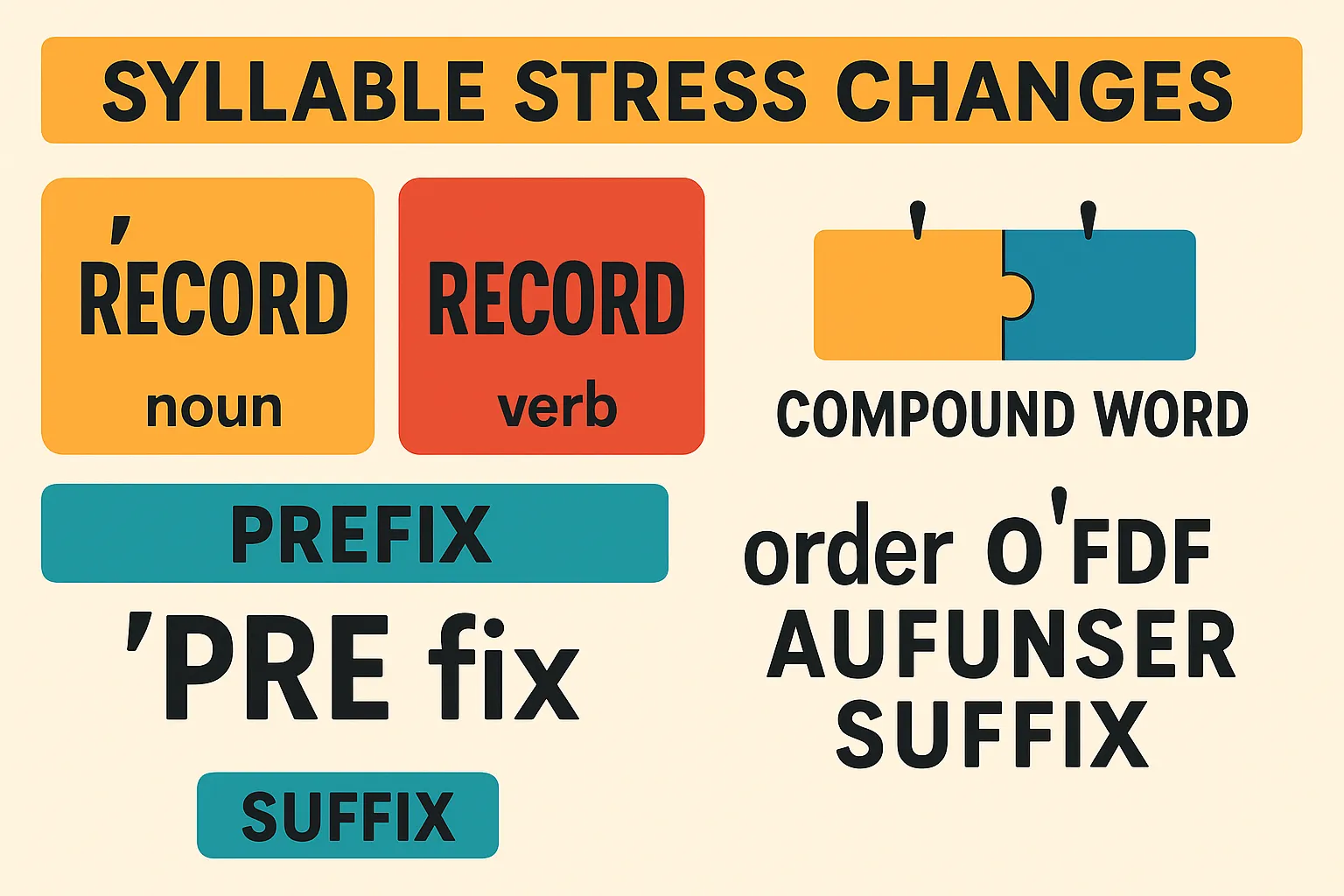
Syllable Stress and Word Formation: Predicting Pronunciation and Meaning
Syllable stress in English not only shapes how words sound but, in many cases, also changes their meaning. Recognizing these stress patterns empowers learners to approach new vocabulary with confidence, making spoken and written English clearer and more precise. This guide breaks down the rules you need to know about syllable stress, focusing on word formation through prefixes, suffixes, and compounds.
Why Syllable Stress Matters
English is a stress-timed language. This means that some syllables in a word are stressed (said louder and longer) while others are unstressed. Getting the stress right can:
- Clarify meaning (e.g., record as a noun vs. verb)
- Signal parts of speech
- Help you sound more natural and avoid misunderstandings
Syllable Stress and Word Meaning
Certain English words change meaning depending on which syllable is stressed. A classic example is record:
| Word | Part of Speech | Stress Pattern | Pronunciation |
|---|---|---|---|
| record | Noun | RE-cord | /ˈrek.ɔːrd/ |
| record | Verb | re-CORD | /rɪˈkɔːrd/ |
This pattern appears in many other English words:
- CONtract (noun) vs. conTRACT (verb)
- IMport (noun) vs. imPORT (verb)
- PREsent (noun) vs. preSENT (verb)
Generally, for two-syllable words, the first syllable is stressed if the word is a noun or adjective, and the second if it's a verb.
Stress Patterns for Prefixes and Suffixes
When words gain prefixes and suffixes, their stress patterns can change — or remain the same, depending on the affix. Here are some common rules:
1. Prefixes
- Most prefixes (un-, re-, dis-, in-) do not get the main stress.
Example: unhappy (HAP-py), rewrite (WRITE)
2. Suffixes
- Suffixes that attract stress: Some suffixes move stress to a new syllable, often the one just before the suffix.
-ee, -eer, -ese, -ique: Stress usually goes to the last syllable.
Examples: employEE, voluntEER, JapanESE, technIQUE - Neutral suffixes: Many suffixes don't change the main stress in the word.
Examples: hopeful, useless, teacher
Stress in Compound Words
Compound words (two or more words joined together) follow their own patterns:
- Noun compounds: Main stress is typically on the first part.
- Example: BLACKboard, TOOTHbrush
- Adjective compounds: Stress usually falls on the second part.
- Example: old-FASHioned, bad-TEMpered
- Verb compounds: Stress often falls on the second part.
- Example: to overCOME, to underSTAND
Quick Reference: Syllable Stress Patterns
| Word Type | Usual Stress Rule | Example |
|---|---|---|
| Two-syllable nouns/adjectives | First syllable | TAble, HAPpy |
| Two-syllable verbs/prepositions | Second syllable | reLAX, reTURN |
| Prefixes (un-, re-, dis-) | Not stressed | unHAppy, reMARK |
| -ee, -ese, -ique suffixes | Final syllable | empiOYEE, JapanESE |
| Noun compounds | First part | TOOTHpaste |
| Verb compounds | Second part | overCOME |
Empower Your Pronunciation and Vocabulary Skills
Understanding the patterns of syllable stress removes much of the guesswork from pronouncing new words. By applying these rules — especially to words with prefixes, suffixes, and compound forms — you gain tools for more accurate pronunciation and meaning recognition. Keep these stress patterns in mind whenever you encounter unfamiliar vocabulary, and soon, stress will work for you, not against you.