Word Family Mastery: Nouns, Verbs, Adjectives, Adverbs

Master English word family transformations: Learn to systematically build vocabulary by converting nouns, verbs, adjectives, and adverbs for confident, varied expression.
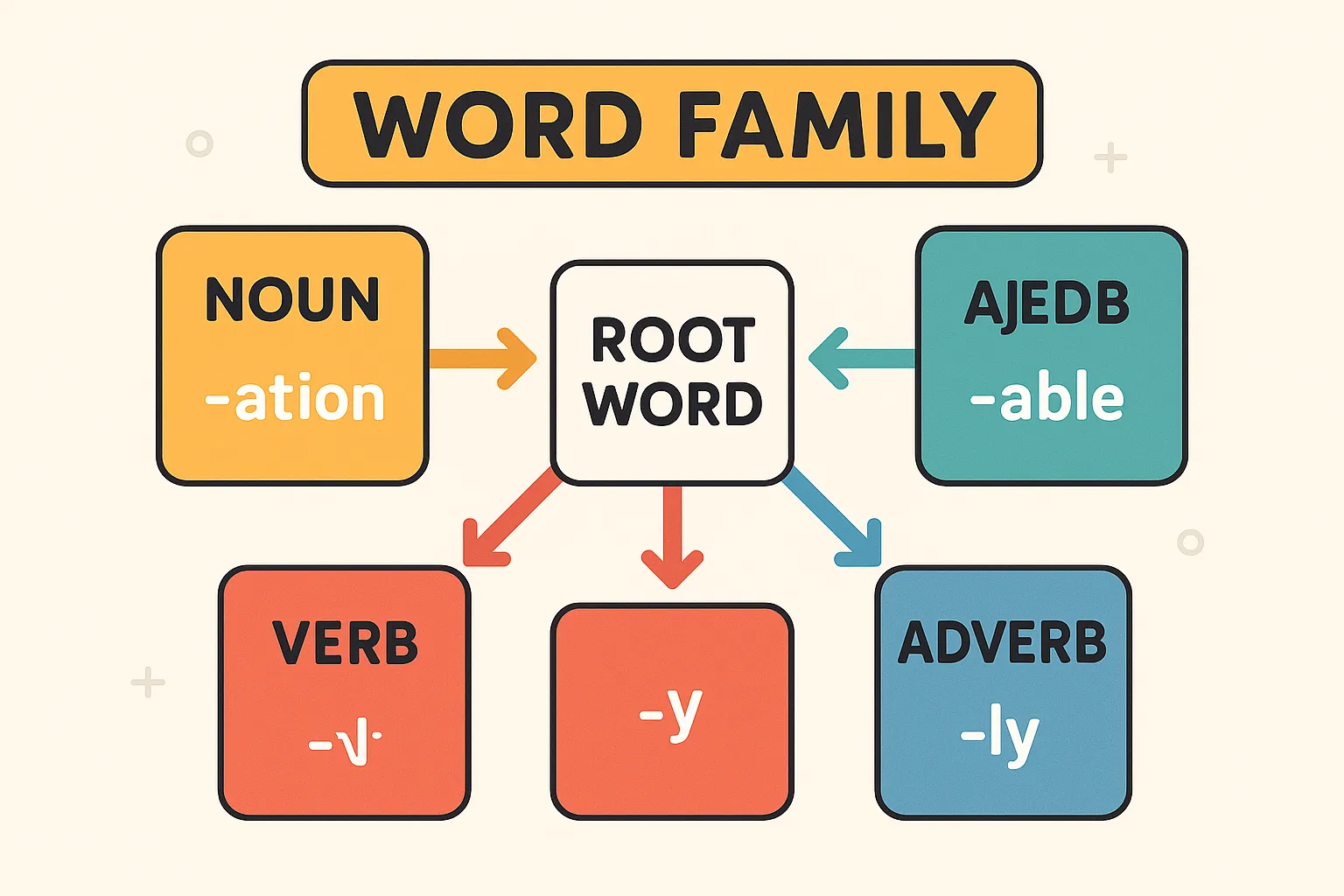
Practical Approaches to Word Family Mastery
Achieving fluency and expressive power in English requires more than simply knowing individual words. Understanding word families—how related nouns, verbs, adjectives, and adverbs are formed and used—empowers learners to expand vocabulary, improve writing variation, and communicate clearly.
Why Word Family Mastery Matters
- Vocabulary Expansion: Learn one root, gain three or more related words
- Writing Fluency: Avoid repetition by using precise forms
- Exam Success: Recognize and use correct word forms, a common test requirement
Understanding Word Families
A word family is a group of words sharing the same root and related by meaning. For example: success (noun), succeed (verb), successful (adjective), successfully (adverb).
How Words Transform: Morphological Overview
Mastering English word formation involves learning common suffixes and occasionally recognizing irregular forms. See how transformations typically occur:
| Root/Noun | Verb | Adjective | Adverb |
|---|---|---|---|
| success | succeed | successful | successfully |
| decision | decide | decisive | decisively |
| beauty | beautify | beautiful | beautifully |
| creation | create | creative | creatively |
| strength | strengthen | strong | strongly |
| danger | endanger | dangerous | dangerously |
| analysis | analyze | analytical | analytically |
Irregular and Unpredictable Forms
Not all transformations follow the same pattern. Some word families have irregular forms or borrow from other languages, so simply adding a common suffix may not work.
- Think → thought (verb to noun, not *thinkness)
- Good → well (adjective to adverb, not *goodly)
- Buy → bought (verb tense changes can affect noun and adjective forms)
Consulting a trustworthy dictionary can help in uncertain cases.
Key Strategies for Word Family Mastery
- Learn Common Suffixes: -ion (noun), -ify/-ize (verb), -ous/-ive/-ful (adjective), -ly (adverb)
- Build Family Charts: For each new word, list all family members you know. Add others as you encounter them.
- Focus on Usage: Notice how forms appear in context (e.g., "make a decision" vs. "decide quickly")
- Expand with Synonyms: Group words with similar meanings across word forms for richer choices (e.g., success—victory—achievement)
- Keep a Word Journal: Track new roots and their transformations as you read or listen in English.
Integrating Word Families for Writing and Speaking
To sound natural and varied, substitute within a word family as you compose:
- Original: The team had success because their plan was a success.
- Improved: The team succeeded because their plan was successful.
Notice how shifting forms prevents repetition and creates more professional, fluent expression.
Conclusion: Build Depth, Not Just Lists
Systematic study of word families deepens your vocabulary and improves your reading, writing, and test-taking abilities. Start by focusing on frequently used roots. With practice, manipulating word forms will become a natural part of your English use—boosting both confidence and style.